Athens Olympic Ceremonies Raise the Bar
October 21, 2004
Remarkably, the Summer Olympic Games just keep getting better and better. If Sydney was spectacular then Athens was nothing less than astounding.
The Athens 2004 Summer Games have come and gone and all went well from every aspect. The pre-Olympic jitters concerning unmet deadlines and unfinished venues proved unwarranted as Greece put on a spectacular show. From an artistic and lighting perspective as well, the Games were a stunning success.
On the evening of August 13, 2004, the eyes of the world were fixed on the Olympic Stadium in Athens where a total of 648 Martin MAC 2000 Wash were used as an integral element of a spectacular Opening Ceremony. It was the largest event ever for a single MAC 2000 Series fixture.
The MAC 2000 Wash was the main washlight fixture used for the Opening Ceremony and was also an integral part of the closing festivities on August 29th. The Martin fixtures were supplied through several key rental companies, part of a complete and comprehensive lighting package as required by American lighting designer Bob Dickinson and lighting designer Eleftheria Deko of Greece. Event producers were Jack Morton Worldwide.
Raising the bar
Bob Dickinson, who has been involved in four Olympics (three as a lighting designer), has personally witnessed the ‘raising of the bar’ over the years. He explains, “In 1984 Los Angeles included a high level of entertainment to what before had basically been large groups of folk dancers. They did things that were not considered standard for an Opening Ceremony and at the time it shook everything up. Barcelona raised the bar again and when Atlanta used conceptual pieces that really had meaning, it raised it even further. And then Sydney was just fantastic.”
Uniquely Greek
For Athens, the creative team was made up of local talent. “The Greeks wanted to do something unique to them and now the bar has been set even higher,” Bob states. “The creative team was Greek, and approached it from a Greek perspective. They had never done such a large-scale production before and because they didn’t have the prejudices that experience in large projects often brings, they were incredibly brave. They basically said, ‘why can’t we do it this way?’ They used high concepts that were not easy to understand and mechanically difficult to achieve but they basically said ‘damn the torpedoes, full speed ahead’, and did a fantastic job. The experience for anyone in Athens was one of absolute perfection. The result was so magnificent.”
A key member of that Greek creative team was lighting designer Eleftheria Deko. She commented, “None of us in the creative team had previous experience on an event of such a big scale, although we had a very strong background, each in our own field. This had the advantage, I believe, of approaching the ceremonies with a very fresh look. We dared to imagine, and pursue, things that at first looked impossible or at least not common in ceremonies.”
Lighting’s role
One of the very first things Eleftheria knew for sure was that lighting would play a very important role at the ceremonies. “Even at the very early stages of the creative process we were visually ‘dressing’ the scenes with lighting. The approach for the lighting was that of a painting. We wanted to create strong, clear images where lighting would stress and underline the message and not distract or show off.” The result was lighting that was very precise and specific for every scene.
MAC 2000 Wash
A significant element of that design was the use of some 1700 lighting fixtures including 648 MAC 2000 Wash. “A year before the show we tested several instruments, including the MAC 2K Wash,” Eleftheria continues. “We were very satisfied with its luminosity as well as the fairly even output across the beam spread and the elimination of the center hot spot. In the show, they played a very important role, as it was the only washlight fixture and almost half of our gear. They performed excellent, enabling us to achieve great luminosity in long distances and even spread. In general, it is an excellent, dependable, bright light.”
Lighting scenic elements
The scenic environment was made up of a variety of elements, both stationary and flying, and included a central water area, a lip around the water and a track around that lip. Bob Dickinson comments, “All of the elements had to be lit extremely discreetly in order not to have any color overlap, especially water separated from the white lip. And then there were all the rocks flying in the air that had to be lit very carefully in order to not cast big rock shadows into the water. If we had lit it in a more general manner we would have used far fewer instruments, but because we were very, very specific we kept everything cropped in and spotted in and the result was that it took more instruments to accomplish it. That’s what gave it its clean look. There were very few points during the production where the moving light rig was not in use to near capacity. It was a huge undertaking in area and we did a highly specific lighting design although it looked very general to the eye.”
Location, location, location
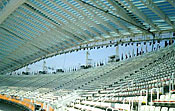
The MAC 2000 Wash were located on three levels, a primary position on the roof construct and balcony rail mid level, with several located at field level. “We had an advantageous positioning because of the Calatrava roof that enabled us to mostly hang the lights at very desirable angles,” Eleftheria states. “As the water was such a mirror like surface, we took into consideration that the rig, on the roof and on the balcony, should also be symmetrical so that its reflection in the water would give a luminous ‘necklace’ effect.”
Bob concludes, “The MAC 2000 Wash was fantastic. They were an unbelievable workhorse and the backbone of the lighting design. Their abilities in long throw format situations are remarkable. We were throwing the light distances an average of 60-75 meters with some throws well in excess of 200-250 meters. We actually used the MACs to light the far end of the stadium at times. The equipment did perform remarkably. After some initial problems were dealt with they were incredibly dependable, a wonderful performing instrument.”
Combined with other lighting effects, the Opening and Closing Ceremonies were a stunning spectacle, admired by lighting and sports fans alike. After the Olympic Games the Martin fixtures were also used for the Opening and Closing Ceremonies of the Athens Paralympic Games at the same stadium. Much of the key lighting crew stayed in Athens for both events.
Lighting:
Lighting Designer and Director: Eleftheria Deko
Co Lighting Designer and Director: Robert A Dickinson
Associate to the Lighting Designer: Theodore Tsevas
Lighting Director: Ted Wells
Moving Light Director: Andy O´Reilly
Programmers: Mark Butts, Christian Hubbard, Mark Risk
Production:
Producer: Jack Morton Worldwide
Executive Producer: Andrew Walsh
Senior Technical Director: Adam Wildi
Technical Director: Nick Eltis
Senior Production Electrician: Nick Jones
Lighting Project Supervisor: Jason Trowbridge