Australian Pavilion World Expo Lit By Martin Manias
June 15, 2005
The 2005 World Exposition is currently on in
The Australian pavilion reflects this theme – “Nature’s Wisdom” – from an Australian perspective. Visitors to the Australian pavilion gain an understanding that through learning the lessons of the past and using modern day technology, we are better able to provide for the sustainable future – environmentally, economically and socially.
The pavilion showcases Australia’s unique lifestyle – a lifestyle that has been shaped by the harsh and beautiful continent and has been influenced and enriched by the people that have come to its shores, including indigenous Australians, European settlers in the 18th and 19th centuries, and more recent arrivals to Australia from Asia and all around the world.
The Australian Department of Foreign Affairs and Trade is the overall project manager for the Australian pavilion.
Journey in three acts
The Australian Government appointed Melbourne-based firm Think!OTS to design, construct and maintain the Australian pavilion. Think! OTS joined forces with the major Japanese exhibition company Delphys Inc, which has been designing and building pavilions stretching back to the World Expo held in Osaka in 1970. Leading indigenous design firm Balarinji is also part of the Think!OTS team.
Phil Lethlean was appointed as lighting designer for the Australian pavilion with Lightmoves supplying most of the lighting equipment.
The pavilion provides a journey in three acts starting with an entrance foyer which houses a Martin Mania that projects the word ‘Eternity’, written in Japanese.
“I thought that would be a fun element,” said Phil. “The Manias are fantastic for this type of work. We just whipped out the standard gobos, played with the lenses a bit and inserted our own gobos. It gives us an animated feel.
“We also bypassed all the transformers on them so that we could dim them bearing in mind everything is 100 volts in
In fact the Australian pavilion is saturated by Martin Manias – DC1’s and DC2’s – thirty two in total, all supplied by Lightmoves through Martin’s Australian distributor, Show Technology.
“They really deliver bang for your buck!” commented Phil.
Act One
Act One takes visitors back 65,000 years to a time when
Six Martin Mania DC2’s fade up and down with custom-made gobos replacing the standard fire gobos. A lot of the artwork for the new Mania gobos was done by the design firm Balarinji including stylized fire and rain, plus a snake.
”We also took out the double lens in some of them, leaving just a single lens, and focused them onto the Piezo glass that encases the display,” explained Phil. “As we had put in our own transformers they could fade up and down; all of the motors run of normal mains with just the lamp transformer running separately.”
Act Two
Act Two projects a dynamic and positive image of contemporary
Act Three
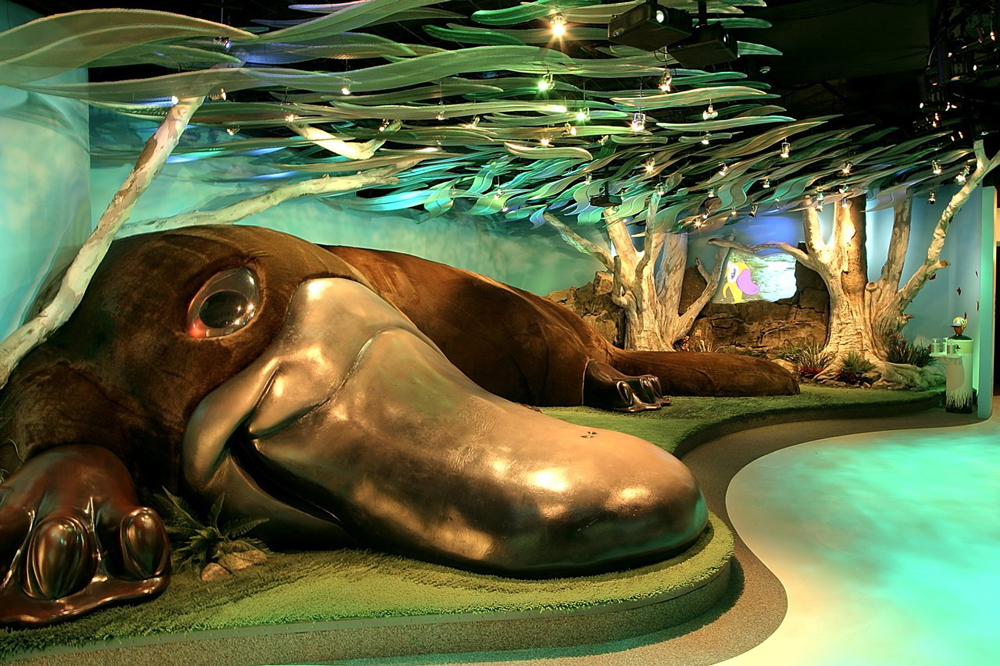
Act Three introduces guests to the future through the pavilion mascot – the platypus. For
With the proactive cleaning-up of
Most of the Martin Manias are located here – Mania DC1’s - representing a river; the white walkway acts as an ideal projection surface for the ceiling mounted Manias which project a watery effect along the path.
“It flows at the right speed and there is very little shadow cast from the people,” said Phil. “It really looks like a swirling stream.”
Other lighting includes sixty PAR 16s on droplets in the ceiling which is made of weld mesh and pressed perforated aluminum leaves through which the lights shine on a flicker chase. Behind the trees are a few 18-watt fluorescents to wash the wall. Control was LSC two phase racks built especially for the project. Also highlighting the importance and the breadth of the Australia-Japan relationship, the pavilion has a specially-designed Trade Floor where more than 130 business events, VIP functions and seminars for community participation take place.