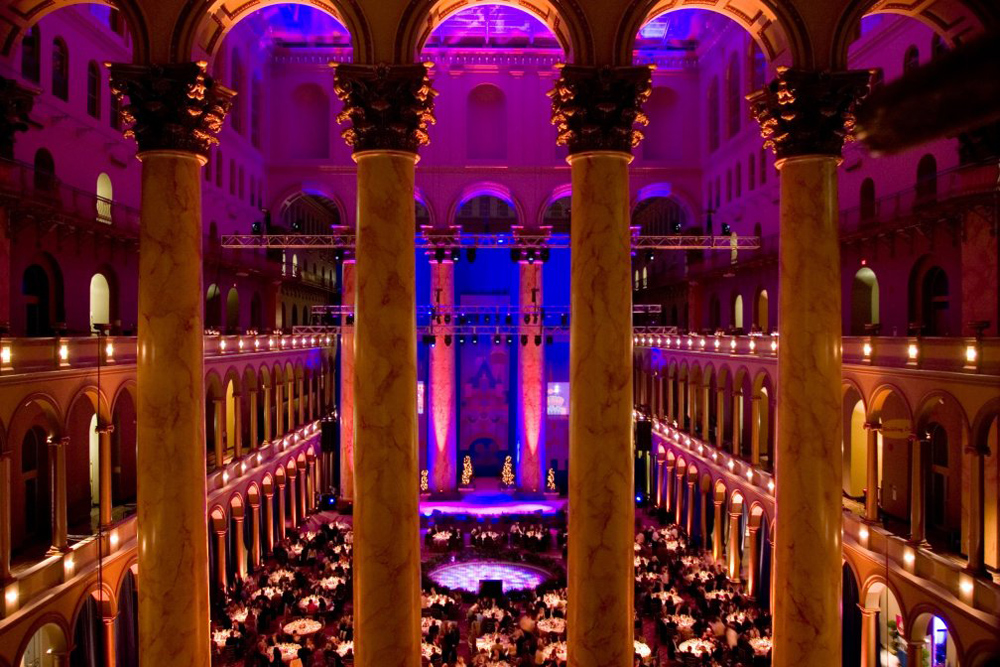
Global Travel and Tourism Summit Gala Dinner
May 18, 2006
On April 11, 2006 the World Travel and Tourism Conference came to a close with the Global Travel and Tourism Summit Gala Dinner. This year marked the first time the event has been held in the United States. A complete Martin package of MAC 2000 gear was used to dress the event in color and texture with control from Martin’s Maxxyz lighting console.
The event, hosted by Jay Rasulo, Honorary Chairman of the Travel Industry Association and Chairman of Walt Disney Parks and Resorts, included an extravagant 5-course meal, addresses by VIP’s from the World Travel and Tourism Conference, The Walt Disney Company, UNICEF, and Julie Andrews, Honorary Ambassador for Disneyland’s 50th Anniversary. The evening was capped off by a performance of “It’s A Small World” and “One” (a song written for the opening of Hong Kong Disneyland). Performers included Julie Andrews, 4 vocalists, 7 Disney characters, and 70 children from an international children’s choir.
The Design Intent
Disney and lighting designer KC Wilkerson were tasked with lighting the event in the Great Hall of the National Building Museum in Washington, D.C. “We were included from the earliest stages of planning with our Show Director, John Addis, which is always good,” commented KC Wilkerson. “We were able to collaborate on a design intent that incorporated a warm, welcoming ‘walk-in’ look, followed by five different saturated dinner looks (each look paired to the dinner course), numerous varied looks for the various VIP’s, and finally, a wide variety of ‘Disney’ looks for the performance portion of the evening, drawing on the Disneyland 50th Anniversary color palette of Royal Blue, Cranberry, and Gold. All of the looks were to read not only to the live audience but on camera as well, since the performance portion of the evening was sent out over the Verizon V-Cast network.”
The Venue
The National Building Museum, formerly known as the Pension Building, was completed in the late 1800’s and is an astounding space in which to work, says KC. It is comprised of 4 levels of offices surrounding an atrium 300’ long, 100’ wide, and 122’ tall. Dividing the Great Hall into thirds are two sets of four massive columns, each 23’ in circumference and 75’ in height.
“Each level of the building has a balcony that runs around the interior of the building,” KC explains. “The steel ribs that support the ceiling have numerous rig points, making the installation fairly easy to plan and design. However, hanging the truss at a desirable height of 40’-45’ would mean that the truss would appear to visually cut the huge columns in half. Given that the set and the immense backdrop incorporated the architectural columns into their design, visually de-emphasizing them was not an option. We initially decided to trim our four truss runs (each 85’ in length) at 65’, but adjusted each of them slightly lower once on sight.
“We had some discussions about using fixed lighting from the balconies but ultimately decided that we wouldn’t be able to get the angles we needed for the performance. We were asked, for financial reasons, to consider conventional fixtures on the trusses but declined to pursue that for a number of reasons. The conventional rig would have to be huge to give us the variety we wanted and we were concerned we would not have enough time to focus and program given that we only had about 14 ‘lighting hours’ on-site. That, and the fact that the building would not allow boom lifts in the space for focusing, convinced everyone we needed a flown all-moving head rig.”
MAC Rig Delivers
The MAC rig was made up of MAC 2000 Wash, Profile and Performance fixtures. KC explains, “With our main front light truss 60’ from the stage and 65’ in the air, we decided that the MAC 2K Wash would be our workhorse for the gig and it didn’t disappoint. We used a total of 24 fixtures for front, top, and back light. It really delivered the punch we were looking for. We were able to use them zoomed in for stage looks but were also able to cover the room in different washes of color when they were zoomed out. We also used 18 MAC 2K Profiles with standard gobos for high sidelight and effects. We got some really nice looks from these, especially the four we used on the large fountain in the middle of the Hall. Given that we also had to light a large backdrop consisting of three long banners, we decided on the MAC 2K Performance. We specified the light for the shutter feature so we could light only the banners and stay off the columns and other scenic elements. Six of the fixtures were positioned on our front trusses and the remaining two were used on our upstage truss to provide strong backlight for our main stage entrance. When the Performances were not lighting the banners, they were busy moving and providing additional color and breakups.
“One of the more inspired design decisions we made was to place 12 MAC 2K Profiles on the top of the trusses. This allowed us an optimal position from which to hit the ceiling of the venue which is white and takes light really well. We specified the Woodroffe Gobo Collection for these and they looked spectacular. All of the gobos in the collection are quite nice but the standouts for us were Matticus, Molten, and Quintuple. The range of looks we got from these three in combination with various colors and prism effects was stunning. Then, we turned our attention to the columns. Each column behind the stage got two MAC 2K Washes (each offset at approximately the ‘4 o’clock’ and ‘8 o’clock’ positions) for modeling and one MAC 2K Profile (at the ‘6 o’clock’ position) for pattern and movement. We actually ended up using these less than originally planned but they looked beautiful nonetheless.”
Fixed Lighting
Also used on the event were 24 Color Kinetics ColorBlast12’s as a bit of uplight for the backdrop, 8 ETC Source 4 Narrow PARs as up-lights on the columns opposite the stage, 60 ACL Pinspots for each of the guests tables, 24 PAR 38’s on each of the smaller columns surrounding the room, and 2 haze machines. The initial idea was to use the CK ColorBlast 12’s for uplighting of VIP’s, KC says. “Julie Andrew’s management had also requested that we give her an appropriate amount of fill for her eyes. Ultimately, those didn’t work out so Benji Tschudin, our rep from Atmosphere, Inc. suggested using four 10-degree ETC Source 4’s at a low angle fairly far back in the house. We tried it and it looked surprisingly good. Walking that fine line between looking good on the camera and to the live audience can be fairly tough, but I think we managed to please both audiences.”
Martin ShowDesigner
Music for the performance was pre-recorded so KC asked for a reference CD with SMPTE time-code in order to pre-program the lighting in ShowDesigner, Martin’s lighting and set design software package. “Due to some fairly late creative changes to the reference CD, however, we were unable to program the show prior to our arrival in D.C,” KC adds. “Given that we had some time on-site, this didn’t negatively affect us to a great degree, other than slightly reducing the overall number of cues. (My programmer, Ed Motts, tells me I tend to over-cue anyway, so maybe having to cut back on cues wasn’t a bad thing...). Where ShowDesigner came in handy, though, was in confirming fixture placement. It’s always nice when the software confirms the math I had done a month prior as far as field angles are concerned.
“The only fixtures we changed placement on were the side-light Profile fixtures. We ended up moving them farther out on to the extreme ends of the truss to give us a more relaxed side-light angle and to create a wider ‘envelope’ for the beam to travel through on fly outs. Seeing the effect of the change on screen was instrumental in moving the fixtures. And of course, with ShowDesigner we were able to send all of our paperwork to our lighting vendor in advance, which is always a huge help.”
Maxxyz and Wing
Lighting control for the event was provided by the Martin Maxxyz console. “Since this was such a high-profile event for our company we were adamant that there could be no room for error. I have been witness to a few console failures over the years and had no desire to see my career go down in flames on this event, so we decided to run a primary console with a redundantredundant backup via the Maxxyz Ethernet node. We also used the Maxxyz Wing, which was a first time for me, and it worked perfectly. This set-up worked very well and is something I will do again for high-profile events.
“We have had the Maxxyz out on numerous gigs for the last 3 years or so and have been witness to its growth. We have come to expect great things from this console and it ALWAYS delivers. One of the features I love is being able to plug a standard CD player into it and play a reference CD (with one channel of audio and one channel of time-code) and have the console execute the show. I can sit there, stop the CD, start it again, reprogram a look, stop and start again – anywhere in the track, and the console keeps up, freewheeling until it sees the next SMPTE cue, then picks up the show in exactly the right spot. We had a fairly complex cue list which contained multiple cues with various fade times and numerous other constantly changing parameters, in addition to running a ton of MACros, and the console didn’t flinch.”
Sharing the Success
The event was a great success with a great many compliments received which KC eagerly shares with several individuals. “Benji Tschudin, our contact at Atmosphere, Inc. did an excellent job. He worked with us from the beginning, imparting his intimate working knowledge about the building and what he knew would and wouldn’t work. He supplied a crew that was highly skilled, on time, hard working, and REALLY easy to get along with. Three of his crew members in particular – Will Johnson, Andy Horodowicz, and Billy Koch all did an outstanding job. It’s also worth noting Atmosphere’s gear was in great shape. Credit should also go to my programmer Ed Motts, with whom I’ve worked for 6 years. We’ve developed a communication short-hand over the years, which is nice to have around when words escape me at 4am and I’m reduced to questionable thumbnail sketches and hand-shadows to describe what I’m looking for. He’s great with ShowDesigner and knows the Maxxyz like the back of his hand.”
GTTS Gala Dinner Credits
Disneyland Entertainment Productions Staff
Producer: Greg Smith
Production Manager: Kristin Todd
Show Director: John Addis
Art Director: Dan Torres
Lighting Designer: KC Wilkerson
Technical Director: James Brown
Disneyland Lighting Technicians
Programmer: Ed Motts
Crew Lead: Joe Peters
Lighting Vendor
Atmosphere, Inc; Benji Tschudin