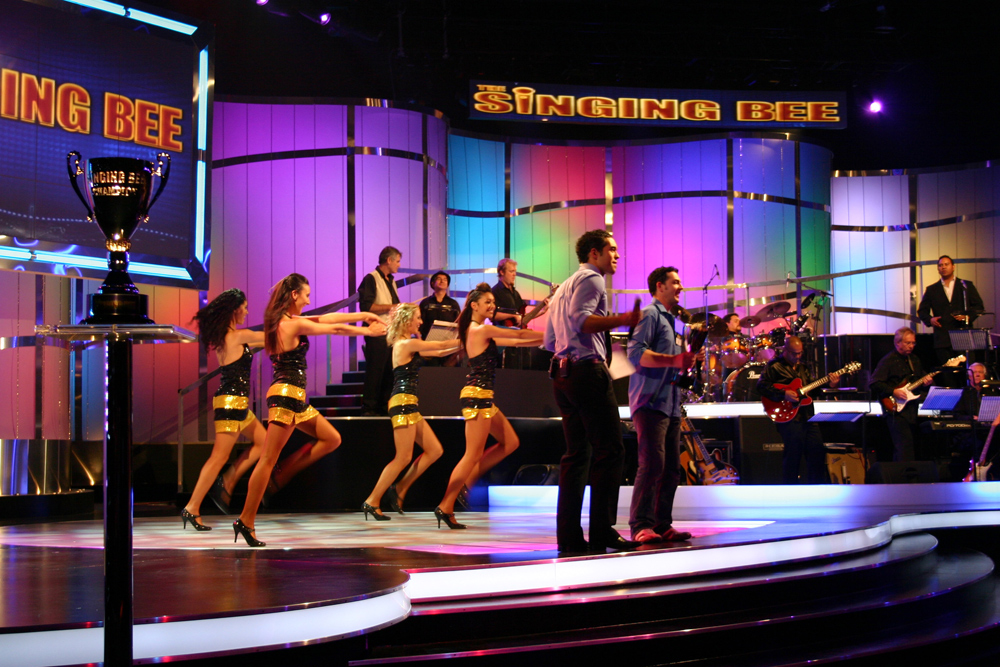
Martin Rig Hits the Right Note on “The Singing Bee”
May 26, 2008
“The Singing Bee” is the local New Zealand production of the US format show of the same name. The singing competition combines karaoke with a spelling bee as contestants try to remember the lyrics to popular songs.
Airing on New Zealand’s TV2, Lighting Director for the show is Chris McKenzie of Martin Professional distributor Kenderdine Electrical Ltd. Chris turned to a host of Kenderdine supplied Martin lighting gear including Stagebar 54™ LED luminaires and MAC TW1™ tungsten wash units.
“When I was engaged by the local production company Great Southern Television to light this show, I was given the US production bible by the Executive Producer, Tony Holden,” Chris explains. “We were to create a New Zealand version of the show with a New Zealand budget to match. In discussion with the designer, we decided to keep the overall look of the show but to scale some elements down to fit budget and studio size available to us.”
Waves of color
The major visual element of “The Singing Bee” set is a cyclorama-like backing created by eight large S shaped panels. “When we saw that the Australian production had used an RP screen material and LED sources to back light it, we decided that this was the way to go,” Chris says. “We set up a test with the Martin Stagebar 54 LED luminaires and a sample of the material and were blown away with the result.”
A total of 60 Stagebars are used in vertical rows of three to light the 4 x 8 meter cyclorama panels, which allows for waves of color running across the background, a signature look for the show.
“There was a temptation to create multiple pixelated colors on the backgrounds, and in fact this was used on the show’s finale when the host, contestants and band got into serious boogie mode for the closing sequence.”
The bulk of the show used a range of color waves and moves across the background to tie the look of the show together. “For television the Stagebars have plenty of output, and in the saturated colors we found that we had to pull the level back to avoid overloading the cameras. The amber allowed a great range of color mixing, and having white available allowed us to mix some good pastel colors as well as the saturated ones.
“The Stagebars are an amazing piece of kit and made the job very easy along with the ability to program a large number of them easily from the Maxxyz™ control desk,” Chris stated.
“Must have” MAC TW1
Chris used the warmth of Martin’s 1200 W MAC TW1 tungsten color changer to highlight skin tones and for soft back light. “This was my first serious use of the MAC TW1s and I have seriously fallen in love with them,” he stated. “I decided to use four units as front keys for contestants and the host which was great in the rehearsal period as positions kept moving. In addition, I used them for the back lights for these areas. The output in open white and with color is great, and it’s good to be working from a tungsten color balance so that the colors reproduce well on camera. I like to be able to get solid ambers and reds out of a moving head. TW1s will be on my ‘must have’ list from now on.”
Maxxyz intuition
Lighting control was from a Martin Maxxyz™ control desk and Maxxyz PC™. “My programmer, Steve Renwick, has fallen in love with the Maxxyz,” Chris says. “Being a LightJockey user he had a learning curve initially into the Maxxyz, but it is a very intuitive console and he quickly worked his way up to some complicated programming.
“As a TV guy I found the Maxxyz very useful for the linear nature of a TV show so we could set the range of looks through the show, and make them consistent from show to show. When Steve needed to busk some element of the show, this ability was there when he needed it. In addition, I could have some elements under my control with the assignable faders.”
Prior to even getting into the studio, Steve incorporated pencil drawings from Chris into Martin’s 3D lighting and set design software package, Martin ShowDesigner™, in order to get a head start on viewing and working out lighting positions. “I find the latest version an invaluable tool to test looks and positions before a lamp is hung,” Chris says.
Other Martin gear used on the show include “old faithful” MAC 2000 Profiles™ for aerial beams over the stage, along with MAC 700 Profiles™ and MAC 700 Washes™ for stage textures and washes on the dancers and band. Roboscan Pro 918™ scanners are used for aerial beams over the audience. “I do like the 918 for TV,” Chris adds. “The big mirror gives a nice chunky beam for camera.”
Lighting Director: Chris McKenzie
Lighting Programmer: Steve Renwick