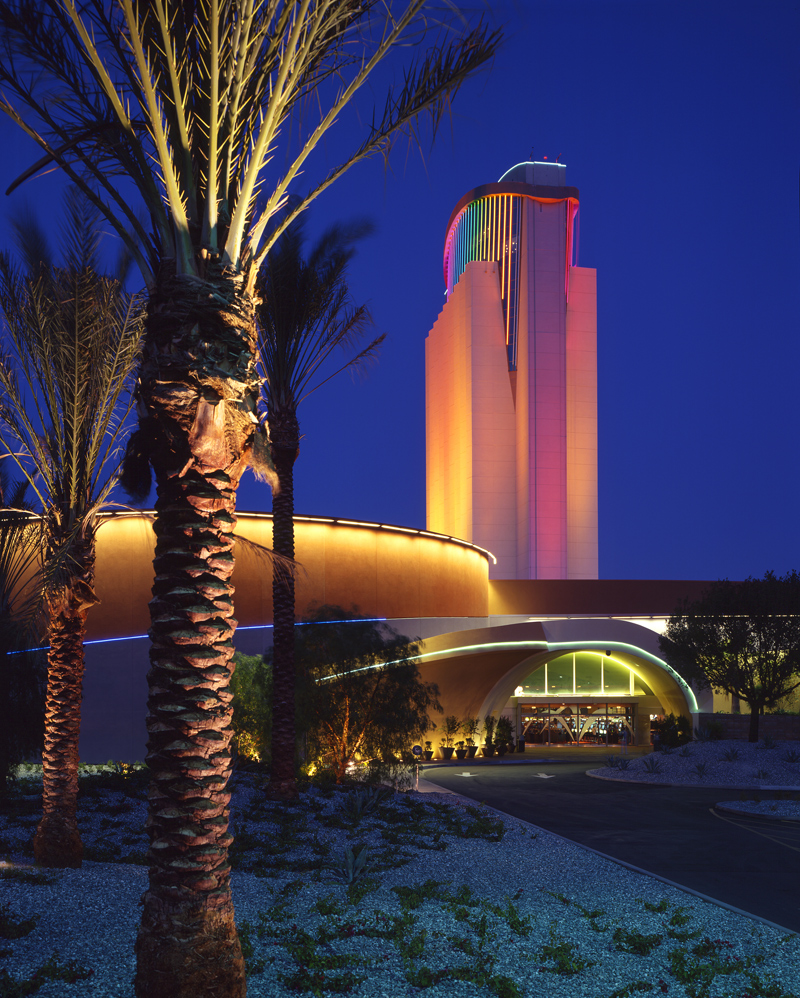
Morongo Casino Resort & Spa
November 09, 2005
Architect: Jerde Partnership
Lighting Design: Visual Terrain, Inc., Principal-in-Charge Dawn Hollingsworth
Award-winning lighting design and theatrical consulting firm Visual Terrain, Inc., has completed lighting the Morongo Casino Resort and Spa in Cabazon, California. As part of a large overall lighting package, Visual Terrain chose some 108 Martin Architectural Exterior 600 color changers to light the hotel tower and main entrance porte-cochere. The Morongo Casino Resort exterior was recently awarded an International Illumination Design Award (IIDA) of Excellence.
The new Indian gaming and resort development near Palm Springs is owned by the Morongo Band of Mission Indians and was inspired by its location among the picturesque mountain ranges, canyons and desert sunshine. The 27-story project is a multi-use resort and hospitality environment that encompasses 44 acres of full development and is visible from over five miles away. Visual Terrain’s project scope consisted of site lighting, parking garage, exterior façades for the tower and low-rise casino, interiors and landscape.
The architect, The Jerde Partnership, requested a color-changing façade for the hotel tower with image projections on the curtain wall at the top two floors. The tower is lit by 84 Exterior 600’s mounted on the casino roof. LED, video and graphics work on the top curtain while the low-rise casino building is downlit with fluorescent wallwashers.
Visual Terrain, Inc.
The four primary lighting designers from Visual Terrain that worked on the Morongo project were managing design principal and principal-in-charge of the project, Dawn Hollingsworth, LC, IALD; company vice president and principal designer, Lisa Passamonte Green; associate principal Eileen Thomas, LC; and senior project designer Matt Levesque. The Visual Terrain designers worked closely with The Jerde Partnership architects to complete the project.
“One of the beginning thoughts and discussions was, what is the nighttime personality of this architecture?” commented Lisa Passamonte Green. “How do we convey that nighttime personality, and how do we make it successful, and how that presence was going to be, and what the story was going to be.”
Visual Terrain used the concept of nature for the color palettes with gradations of color that mix and blend with each other on the tower. The tower cycles on a 60-minute color changing program in a very well-balanced design. Dawn Hollingsworth commented, “We did talk initially about the idea that the tower would be restricted to colors found in daylight, sunlight, sunset, sunrise. We wanted to not make it another building that was changing color for the sake of changing color. The architects obviously drove the initial vision, but we didn’t want it to be just another color-changing building. We also didn’t want it to be a ‘flat’ building. We really went through the idea of the focus, of the number of fixtures, and getting the ability to blend colors on the building as opposed to, ‘OK. The building is now all blue. Or it’s all red, or...’”
Matt Levesque adds, “A lot of the conceptual ideas came from nature. The color palette was created from gradations of colored light, because that’s what natural light does. All the colors blend in and intermix with each other creating an organic mass of colored light that could be seen several miles away.”
Challenges
Of course, such a large project will pose numerous challenges. One of those was integrating the fixtures and making sure they didn’t detract from the architecture. “We didn’t want these [fixtures] to be a big wart on the side of the building,” states Passamonte Green. “We wanted it to be something that was an elegant solution and something that worked during the day as well as at night, because that was really critical for us, and for those of us that worked on those lights. I think that’s true for the porte-cochere lighting, and I think that’s true for the tower lighting. I’ve had several people come back who have driven past in the evening, and said to me, “You know, where are the lights that are lighting the tower?” To me, it’s nice that they can’t see them, or don’t know where to look. It appears as if the tower is glowing on its own volition. It appears as if the façade is just magically lit. I mean there’s something that is magical about the lighting we put in place, and that goes for even the landscape lighting.”
Another of Visual Terrain’s design challenges was to appease the dark-sky ordinances in the area. The exterior required special consideration. “One of the design challenges for us was to decide how we appease the dark-sky ordinances in nearby areas,” said Passamonte Green. “We knew we were going to be doing some uplighting on the tower and we wanted to minimize how we were approaching the overall lighting and the landscape and the area development as well as the façade lighting. It’s the first time that we’ve ever downlit an entire façade (on the lower portion of the building), with the fixtures being mounted on top of the building and lighting down the building in this type of fashion. I think that really was us being conscious of where the casino is located. It was at least an attempt to be cognizant of those things and really pay attention to all of that. I think it was very successful in ‘grounding’ the tower that comes up through the center of the space and helping to ground it to the rest of the surrounding land and the mountains.”
Hollingsworth adds, “I do want to clarify the dark sky was our choice. It was not required. There are some ordinances in other adjacent municipalities, but in this particular case, the sovereign nation of Morongo does not have a dark-sky ordinance. The decision was made as a team, to try to mitigate what we knew we had to do to the tower, which was uplight the tower. We made conscious choices as designers, as opposed to having them imposed upon us. I think that’s important to clarify in terms of the way we think about lighting practice.”
This deliberate effort to minimize energy usage and light pollution influenced their choice of color tone. “The selected palette was very dense for just that reason,” states Matt Levesque. “We’re cognizant of the dark sky, and can’t be a hundred percent perfect, but by saturating the colors and making them heavy helped reduce the amount of light into the sky.”
Passamonte Green adds, “In conjunction with that, we also were very conscious of where we used color on the exterior, and where we chose not to. It was a very conscious choice for the low-rise to be white and for the porte-cochere and the tower to have color - and for the landscaping to have moments of white.”
Porte-cochere
The porte-cochere, the structure over the driveway and main entrance, is in the form of a giant desert bloom with petals that you drive under as you approach the casino entrance. Mounted on the pistil of the flower are Exterior 600’s.
“That had a concept where they actually wanted the light at night to move through the latticework of the porte-cochere petals the way that the sun changed that during the day,” states Hollingsworth. “So they were looking for that same sort of movement—very organic— that they would get at night to simulate the sunlight moving.”
Matt Levesque adds, “One design challenge we had was at the porte-cochere. The Jerde Partnership had shown in the animatic a little animation for the lighting. For exterior lighting, there are not a lot of options for an outdoor rated fixture capable of color changing and projecting a moving pattern. In fact, I don’t think there is actually one still today. I spoke with Lisa about this and she came up with an idea to modify the Martin Exterior 600 fixture. Her idea was to replace the standard effects wheel in the Exterior 600 with Martin’s animation wheel in their MAC Performance fixture.
“Suddenly we had a fixture that was producing animation color mixing and was rated for exterior use. That was exceptional, because we ended up using parts and pieces of things that were already built. And because it was DMX controllable, there was some paranoia about how does that DMX translate to a wheel that needs to continuously loop. Well, fortunately, part of their fixture could handle that, because it already did a continuous spin. So when we went to programming, we just set it to a slow spin and we got what the original concept was. That was a challenge and we were able to meet it without incurring new costs or creating something that somebody had to maintain five years from now and wouldn’t understand what it was.”
The Morongo lighting project was awarded an IALD Award of Merit and an IIDA Award of Excellence at the Lightfair exhibition this past spring. In conclusion, Hollingsworth states, “It’s an emotional project for me. And seeing it all come alive was really rewarding… When it all works, you walk in, and say, ‘Wow, this is great! It looks great, and it all works. And it was all worth it.’”
Note: The Morongo Band of Mission Indians is a federally recognized tribe and operates one of the largest and oldest tribal government gaming facilities in California. As a direct result of the gaming operation's success, the Morongo tribe has eliminated welfare dependency on the reservation.
Client: Morongo Band of Mission Indians
Design Architect: The Jerde Partnership
Executive Architect: Thalden Boyd Architects
Interior Design: The Jerde Partnership and Hirsch Bedner Associates
Lighting Designer: Visual Terrain, Inc.
Principal-in-Charge: Dawn Hollingsworth, LC, IALD
Project Manager and
Interior Project Design Lead: Eileen Thomas, LC
Exterior Project Design Lead: Matt Levesque
Controls System Designer: Jeremy Windle, LC
Project Designer: Lisa Passamonte Green
Project Designer: Stacey Westbrook
Production Manager: Francis Mempin
Environmental Graphics: Selbert Perkins
Electrical Engineer: RHR Consulting Engineers
Grand Opening: December 8, 2004
Installation Cost: $250 Million total project budget
For a full equipment press kit contact Visual Terrain, Inc. at:
Visual Terrain, Inc.
14141 Covello St., Suite 4B
Van Nuys, CA 91405
U.S.A.
Tel: +1 818 787 3110
Fax: +1 818 786 3501