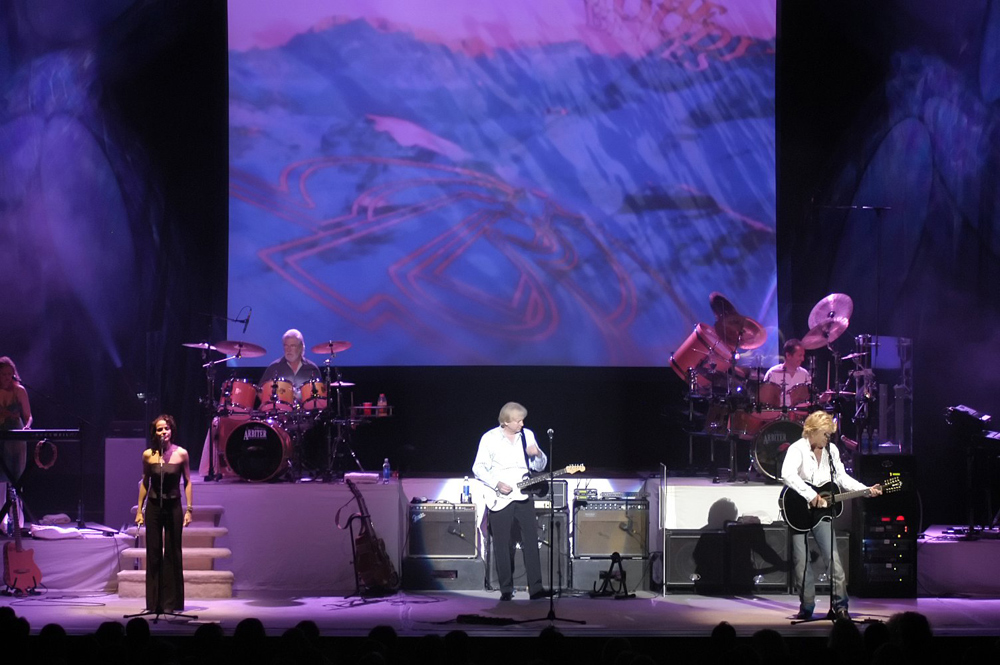
Mick, Maxedia and the Moody Blues
July 19, 2005
When one speaks of classic rock bands The Moody Blues must certainly be very near the top of the list. For over thirty years, The Moody Blues have been musical mainstays. Their first album in 1967 generated such classics as “Tuesday Afternoon” and one of the biggest selling singles of all time, “Nights in White Satin.” From there the band never looked back and now, needless to say, their place in rock history is assured.
Approaching their 40th Anniversary, The Moody Blues are at it again with a tour that sees them touring across
“There has been a progression in the show each year,” he comments. “Last year for example we incorporated moving trusses and effects on to white cycs. The next move was to get video and Bandit recommended the Maxedia. It was also financially viable.”
“Child’s play”
This is Mick’s first experience with the Maxedia. Back in England Bandit provided Mick with a Maxedia system that he quickly got familiar with at his home in
“I got the imagery working immediately and by the end of the first week I had learned new stuff and developed further. It’s as easy as clicking on an icon and I like that it is DMX and you can run it through the controller.”
Depth, texture, intensity and personality
The visual aspect of the show features Moody Blues album covers, works of art in their own right that have had a strong impact through the years. “It’s really historical album work,” Mick states. “The concept was to involve the album artwork in the show, manipulate it, put layers into it, and work it with the lightshow.”
Mick had a good stock of images to use plus files that were already on Maxedia of which there are many. He also uses old Moody Blues photos. “The imagery adds more depth and texture to the show – intensity and personality.”
Used throughout the show to give dimension, the various Maxedia effects are projected using EIXI 10K projectors onto white cycs to form a 3D backdrop. On some songs Mick uses the imagery as a still texture backdrop; on other songs there is more movement. About half the show involves the album imagery as images morph with the old photos. Effects generally involve very slow speed movement, with the myriad of effects encompassing kaleidoscope images, concentric circles moving across the screen, default effects and more. On the song “Question” Mick creates a tunnel effect with an album cover image falling down a tunnel then emerging as a Moody Blues logo.
Mick runs the Maxedia effects through an Avolites Diamond console. He uses a Bandit supplied rig of 16 MAC 2000 Profiles, 120 Par Cans, 8 2-lite Molefays and Source Fours on the show. “Lighting programming works well with Maxedia,” he states.
Complete artistic control
Mick practices balance and discipline with lighting. He is critical of the usage of color and what is “good enough.” Having graduated from art college in the
“With Maxedia it’s like cooking,” he says. “It’s not what you put in but what you leave out. Put another way, it’s often how you use the darkness. You can be spoiled by too many toys. When I have fresh ideas, that makes it. Something specific in my head can be transformed into an image I can use.”
For “Nights in White Satin” Mick often takes a photo of the Moody Blues advert from each show and uses it as a layer in the show that day. The look incorporates white silk from his wife’s wedding dress with a video layer of the advert in the background. “I can go out and take a picture of something specific that I want and use it in the show immediately. It gives the audience something personal. The hands on access of Maxedia lets you do that. It’s the perfect tool to do it with. It will be interesting to see how the show is now and then how it changes two months from now. It makes it less boring.”
Peace of mind
Mick mentions his desire to try and impress some people with Maxedia along the way. “I’m more than happy with the Maxedia. It has been a stable platform and gives peace of mind. I’ve been running it hard but it hasn’t had problems.” Mick does mention the need for a DVD backup, however. “They need to get that in there.”
Mick reports that both the artist and management are pleased. And perhaps most importantly, the feedback from the artists’ wives has been great (which Mick says is often the most important).
Mick also expresses satisfaction with the support he has had and continues to get from Martin’s Michael Nevitt and Matthias Hinrichs. Matthias, who was on hand at rehearsals as well as opening night and showed Mick some tricks with the Maxedia software, commented. “It was nice to see Maxedia run so smoothly on this show. It showed that the hands on visual interface and programming philosophy is very easy to understand for lighting designers. Mick had a lot of fun creating and modifying the cues, and I’m sure he’ll keep working on it for the duration of the tour.”
The tour will finish its summer US leg in July but additional legs are planned for the fall, both in the